




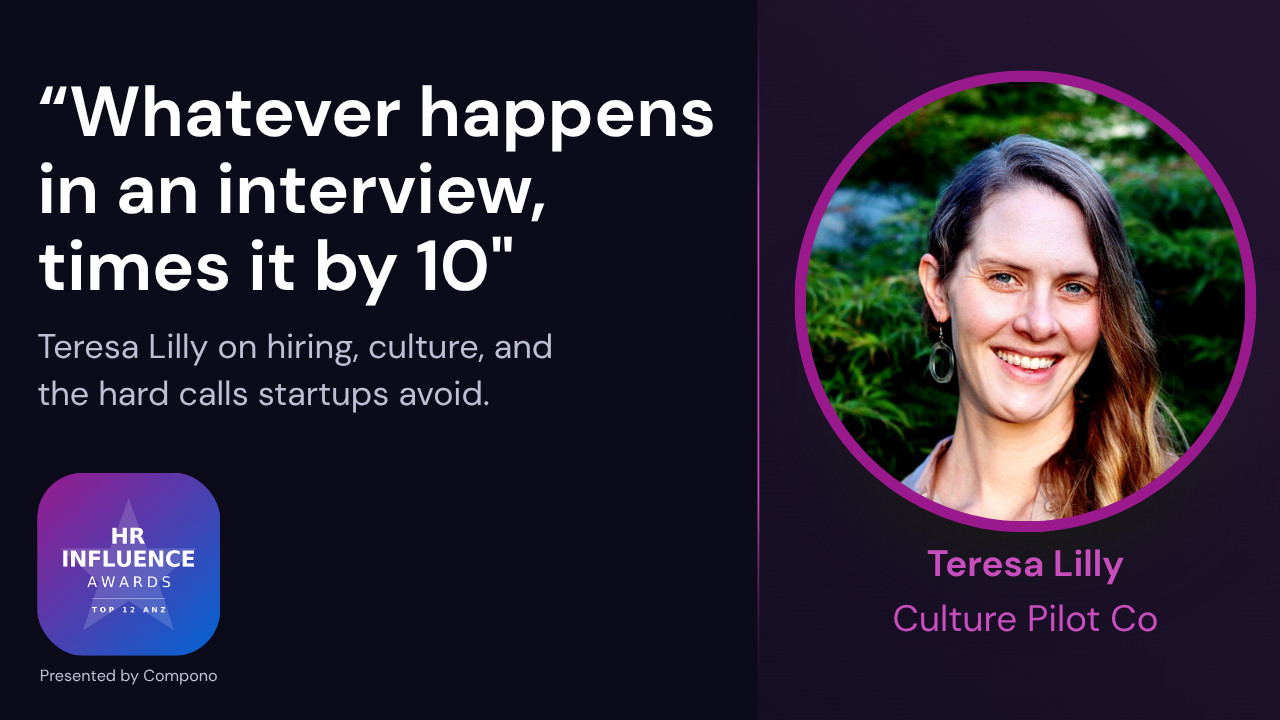
"Whatever happens in an interview, times it by 10": Teresa Lilly on hiring, culture, and the hard calls startups avoid
Teresa Lilly didn't plan a career in HR. She was living in Boston, took a people role at a startup, and something clicked.
Deepak Singh didn't plan to start a business. He didn't even plan to leave his last job. He finished a contract, gave himself six months to find the next one, and got nowhere.
"I thought it would take three," he says. "Still got nowhere."
Watch the full interview with Rudy Crous above.
People kept telling him to go out on his own. He heard it enough times that when someone finally asked him for help on a project, he said yes. There was just one problem. He needed an ABN to get paid.
"So from that I thought, can I build a brand and something out of this?" he says. "And that was it. It was simply a first step. There was no real grand plans, just a step forward, then another one and another one."
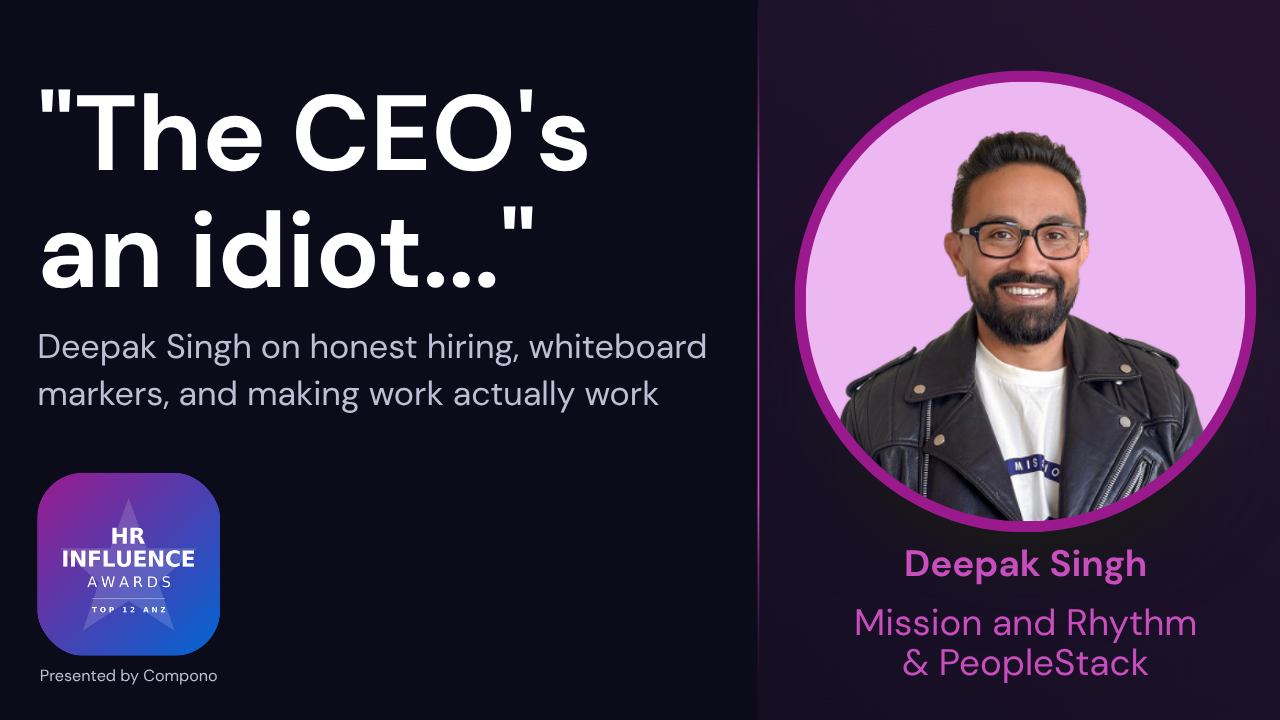
That accidental first step turned into three. Deepak Singh is the founder of Mission & Rhythm, a culture operating rhythm consultancy; PeopleStack, which builds hiring and performance systems for pre-Series A startups; and Just Sing Out, a pre-legal workplace coaching model for individuals. Before going out on his own, he held senior people and culture roles at Uber Carshare and REA Group, where he shifted Gallup engagement from the 25th to the 75th percentile in 18 months. He is one of the HR Influence Awards Top 12 for 2026.
Singh's corporate career spanned global roles in tech, M&A integrations, inclusion strategies, and engagement work. The common thread, he says, was always the same problem showing up in different forms.
"The biggest problems weren't capability problems, they were more decision problems," he says. "Leaders often knew when things were broken, but they didn't act."
That gap between knowing and doing is what eventually pushed him out of corporate life. He wanted to work at the level where decisions actually get made, without the layers that slow things down. "Less policy, more impact," is how he puts it.
He's quick to acknowledge the privilege in the timing. "Sometimes there's a bit of luck and there's privilege involved as well," he says. "I think I just recognised it and ran with it."
Three ventures sounds like spreading thin. Singh has heard that before. But he sees them as the same mission approached from different angles. The through line, he says, is simple: "Great experiences for our business and community, through great experiences for our people."
Mission & Rhythm works at the leadership and system level, connecting culture to what matters to the business. PeopleStack helps early-stage teams build their employee experience with the same intentionality as their customer experience. Just Sing Out supports individuals when the system breaks.
"Different entry points, but all the same mission," he says. "To make work actually work."
The Gallup engagement shift is the number that jumps off Singh's CV. Taking an APAC tech org from the 25th percentile to the 75th in 18 months is a big claim. So what actually happened?
"We made the results matter," he says. "Most companies run a survey, eventually share a few slides, nothing tangible really happens, and then everyone moves on. So we broke that mold and did the opposite."
The first move was speed. Results went back to employees quickly, without spin, without delay, without a corporate message layered on top, without anyone softening the findings. "It was: this is what you said." Then they asked two questions: what does this actually mean to you, and what would actually make a real difference?
They ran six-monthly change sprints with clear actions and visible ownership. Managers who took action were rewarded. Managers who didn't were held accountable, including through their bonus.
The specifics mattered more than the scale. The business had grown through acquisition, and the sales team had six different compensation plans for six different products. Singh's team simplified it to one. "You knew what you'd get as a commission, and you could do that easily, without needing six different spreadsheets and pivot tables to work out what you'd get home at the end of the quarter."
They rebuilt onboarding for new starters, which cut early-career attrition (first 12 months) by 40%.
But the detail Singh keeps coming back to is smaller than any of that. In the first iteration, some teams didn't set ambitious goals. They asked for working whiteboard markers.
"It might've been something as simple as that," he says. "We want whiteboard markers for all our whiteboards so that we can whiteboard when we want and not walk into a room and go, seven of the eight whiteboard markers don't work and get frustrated and no one does anything."
He laughs about it, but the point is sharp. That first round wasn't about big transformation goals. It was about proving the system worked. Give people something small that changes their day. Then build from there. Each cycle, teams got better at setting goals and owning what happened next.
"It was building and building and building," he says. "Almost building a hurricane, building those circles concentrically and bigger and bigger."

The engagement work required something Singh spends a lot of time on across all his ventures: getting buy-in from people who aren't sure they want to change.
His approach is deliberate. Before the board meeting where the engagement strategy was presented, Singh had already spoken one-on-one with every exec. He identified who would push back, who would champion the idea, and had side conversations with each of them so that by the time they sat down together, the conversation had already been shaped.
"When you got into the meeting, the one that was most likely the challenge would be saying, hey, I actually spoke to Deepak already. I agree, this is the best way forward."
He also made the CEO and exec team go through the process first. When they experienced it themselves, before asking their teams to do it, they became better at leading it. "It's much easier for me to lead this with my team because I've seen it in action," he says, paraphrasing the feedback.
Some people still had to be dragged across the line. Singh doesn't pretend otherwise. "Sometimes that's half the hard work and that's the bit that frustrates you," he says. "But you've got to bring people across the line because as a business, we only succeed as a team."
The second time around, it was easier. People who hadn't engaged the first time had seen the results. And Singh was clearer about the consequences. "We dragged you across the line last time. This is what's going to happen if you don't do it this time."
When the conversation turns to hiring, Singh tells a story that captures his philosophy better than any framework could.
A client came to him with a role to fill. Great role, real impact, good team. But the CEO was difficult. The client's exact words were stronger than "difficult," Singh says, though he cleans them up slightly for the interview.
"They came to me and said, hey, this is a great role, really powerful, but to be honest, the CEO's an idiot."
So they put it in the job ad. Not those words exactly, but close. The leadership would be extremely challenging. The environment would be hard. They had a bit of fun with the language and kept it honest.
"That probably got rid of 60% of people who would normally apply," he says. "But the people who did apply walked in with eyes wide open."
The hire worked. Three years later, the person is still in the role. The culture has improved. And the clarity at the start, Singh says, is what set them up for success. "They knew what to expect. They were prepared for it and it wasn't a sudden surprise punch in the face."
Singh sees this as the same principle that runs through all his work. The employee journey and the customer journey are the same journey. Design both with the same intentionality, and people know where they stand from day one.

Just Sing Out sits apart from Singh's other ventures. Where Mission & Rhythm and PeopleStack work with businesses, Just Sing Out works with individuals who are going through something difficult at work.
"I'm in a tough situation. I think I've been unfairly dismissed. I'm going through an HR process that I don't understand," he says, describing the kind of people who come to him. "They were stressed out of their brains and either they weren't ready for legal representation, it was out of reach, or they weren't sure what to do."
He calls it pre-legal workplace coaching. The goal is to give people a place to think clearly before they act. He helps them understand what's happening, what their options are, how to communicate, and how to protect themselves.
"Less panic, better decisions, and fewer situations blowing up unnecessarily."
The model lets him do pro bono work alongside paid engagements, and keeping it separate from the business-facing work means there's no perceived conflict of interest. Someone he coaches through a tough workplace situation at one company isn't a potential client he's trying to sell consulting services to. The two things stay clean.
Asked whether he's ever made a bad hire, Singh doesn't flinch.
"Of course," he says. "I think most of us have."
But the mistake, he says, wasn't the hire itself. It was how he made the decision and how long he held on before addressing the misalignment. "The longer you wait, the more it costs everyone. The team, the team member, yourself, and in the end your customers as well."
He's blunt about what letting someone go actually feels like.
"In the end, it's a relationship and sometimes some relationships don't work," he says. "Breakups are shit, but they don't have to be bad. We can deal with that in the right way and say, sometimes the environment, the connection isn't the right one. It doesn't mean anyone's a bad worker."
That directness runs through his advice on hiring more broadly. Get alignment on what good looks like across the entire hiring team, not just the hiring manager. Define what the person needs to achieve in concrete terms. "It might be three dot points," he says. "But if you can start with that and be really clear, it's much easier to look for that versus this laundry list of 17 different things."
Singh has a sharp read on the warning signs that a culture has drifted. Slow decision-making. Leaders saying one thing and doing another. High performers getting frustrated. Disconnection between layers of management.
But the one he keeps coming back to is simpler than all of that.
"Lots of activity. Everyone's busy, but no progress," he says. "Everyone's doing stuff, but no one's doing stuff that matters, or it's stuff that's going in seven different directions."
He frames culture as something that's always present, whether you've designed it or not. "The question is more whether it's intentional or accidental." And intentional culture, he says, lives in the small decisions: how feedback is given, what gets rewarded, what gets ignored. Not in the values poster. Not in the onboarding slide deck.
On the question of HR being seen as a cost centre, Singh doesn't sugarcoat it. "Yes, it is still very much seen as a cost centre in a lot of places." But he pushes back on the idea that HR teams should wait for an invitation to change that.
"We have to stop waiting to be invited," he says. "Our role is to understand the business, understand the customer, the people in the business, and really importantly, how that business makes money. So that in turn we bring insight and not updates. We come with solutions and not problems."
He pauses, then lands the point: "If we're only servicing leadership, we're already behind. We're the ones who need to start shaping the direction."

Asked what advice he'd give his younger self, Singh fires off his answers without hesitating.
Start something of his own earlier. It didn't have to be a business. A side hustle, a project, anything. Just start.
Speak up sooner. "Most issues don't need more time," he says. "They need more honesty and willingness to have the conversation. Don't wait for things to be perfect. Start that conversation early."
And the one that clearly matters most to him now: remember that success has nothing to do with a job title. "It's the life that you're building around it," he says. "The work I do gives me more freedom to be more present with my family, reduce some of that stress, and do the things that actually matter outside of work."
The HR Influence Awards judges called Singh's combination of measurable impact and community leadership the strongest in the 2026 cohort. "Three ventures, benchmarked Gallup shifts, and the richest community portfolio we assessed," they noted.
But if you ask Singh what he's proudest of, he doesn't point to any single number or project. He points to a pattern.
"What I'm most proud of is having those opportunities to turn messy, high-stakes situations into clarity and action," he says. "It's not really one thing. It's more about how people feel and helping that business operate in that feeling."
He registered that ABN because someone asked him for help and he needed a way to get paid. Everything since then has been another step forward.
Deepak Singh is Founder of Mission & Rhythm, PeopleStack, and Just Sing Out, Melbourne. He is a 2026 HR Influence Awards Top 12 ANZ, HRD Hot List 2024, Culture Amp Top 25 Emerging Culture Creators 2024, and Culture Amp People Geek Community Board member. Connect with him on LinkedIn.
#HRInfluenceAwards

The HR Influence Awards 2026 Top 12 ANZ are presented by Compono.
Full details at hrinfluenceawards.com.au.

Compono Hire helps you predict job-fit and team-fit using behavioural science, so you can shortlist with confidence.
Request a demoBuilt for mid-market hiring teams.

Voice-first coaching that adapts to your personality. Get actionable steps you can take this week.
Start freeBuilt by Compono. Not therapy — practical behaviour change.