 Compono
"A florist who built a robot to listen" - Edan Haddock
 Compono
Edan Haddock went from arranging flowers to leading talent across six countries at Movember. His AI agent Joel interviews candidates so humans don't...
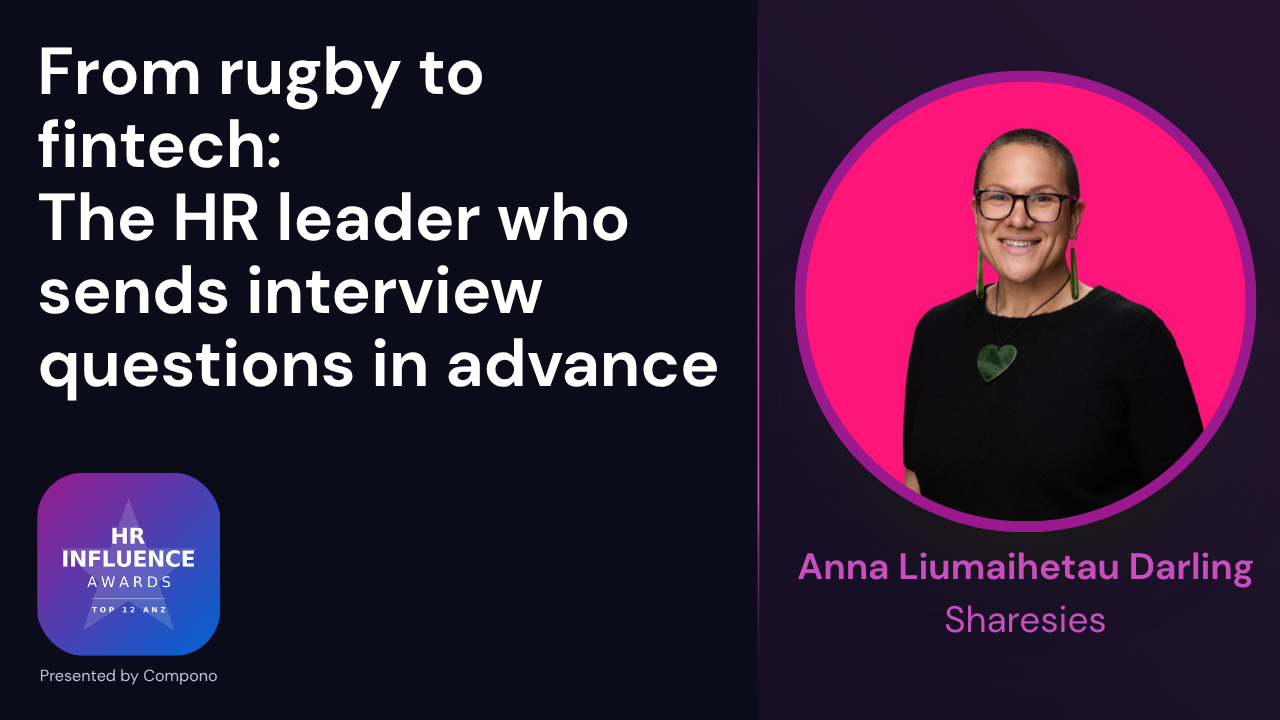
Anna Liumaihetau Darling was a first-year commerce student when she got a job at a call centre. The kind of place that puts everyone on casual contracts so they don't have to pay proper sick leave. She started calling them out on it, doing her own research, pulling apart their employment practices. Someone eventually said to her: "You know, that's HR."
And something clicked.
Watch the full interview with Rudy Crous above.
"Fairness and equity and justice is all so important to me," she says. "I just wanted to make sure that people's experiences at work were going to be good and going to be fair. We spend 40 hours a week at work, at least. I want to make sure people are enjoying themselves there and being cared for."
That instinct, that pull toward making things right for people, has carried her from government departments in New Zealand to rugby fields in the UK, and now to the GM of People Experience role at Sharesies, one of New Zealand's most watched fintechs. Along the way, she's become one of the most distinctive voices in the ANZ people and culture space, and one of the Top 12 in the 2026 HR Influence Awards.
Anna's path into HR wasn't a straight line. After several years in a government department, she and her then-boyfriend (now husband) headed to the UK on their OE. Both of them played rugby, so they got rugby contracts and off they went. She kept working in HR overseas, picking up a different perspective on employment law, working culture, and how people operate in different systems.
When she came back to New Zealand, she landed at New Zealand Rugby, working in their People & Culture function. A few years into her time there she was recruited into the Women's Rugby Development Team. The brief was to help grow women's rugby, a part of the game that had existed for a long time but never had real structure or investment behind it.
"We were basically developing a new product," she says. "Girls and women playing rugby. The men's game worked really well for them, but it wasn't working for us. So we had the ability and the freedom to try things differently."

She spent about five years in that world. And the experience rewired how she thought about people work. If you've inherited a system that was built for someone else, you don't just tweak it around the edges. You ask who it's actually for, and you build from there.
That thinking followed her to Sharesies.
When Anna joined Sharesies, there weren't even 50 people in the company. Today there are around 230. Coming into a startup at that stage meant she could help shape the people practices from scratch, rather than inheriting someone else's policies and trying to retrofit them.
Sharesies' whole purpose is financial empowerment for everyone. They started as an investing platform aimed at first-time and younger investors. They've since expanded into savings, wills, business products, and a B2B arm. The company's co-CEO had already started thinking about wellbeing through the lens of "investing in you," playing on the company's core product. Anna built on that.
"Because we were small, we were nimble," she says. "We could design and create and build with our people, for our people. I always think that is just so key. Otherwise it's so easy for HR people to sit in their office and go, 'this is what we're going to do.' And I did that for years too, because that was what it was traditionally. Policies and processes come from HR, and that's what it is."
She pauses. "I've also worked outside of HR, so I can see how people on the other side react to that."
The shift she made at Sharesies was designing people practices with employees, not just for them. It sounds simple. In practice, it requires a different kind of trust and a willingness to let go of control.
One of the most concrete examples of how Anna builds inclusion into the design, rather than bolting it on afterwards, is Sharesies' recruitment process.
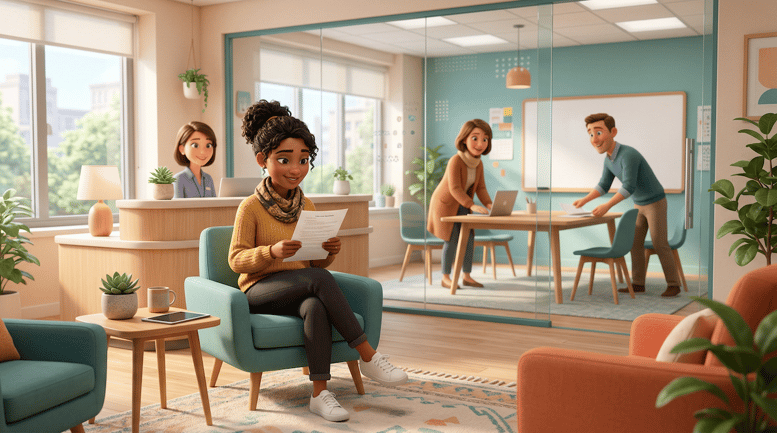
They send interview questions to candidates beforehand. All of them. Along with a brief bio of who they'll be meeting, and even guidance on how to dress. ("Just because there's nothing worse than dressing up too much, or too little.")
It's a choice that some hiring managers would find contentious. Anna knows that.
"Some scary boss is not going to come up to you at your desk and go, 'tell me about a time when...' That's just not how we work," she says. "If someone doesn't have the answer straight away, someone else in a meeting is not going to write them off. So how do we set people up for success right from the beginning, so they can bring their best self to the interview?"
For Anna, this isn't about making things easy. It's about making things fair. She points out that some people, herself included, do their best thinking when they've had time to prepare. Springing questions on people in a high-pressure setting doesn't tell you who's best for the job. It tells you who's best at thinking on their feet in an artificial situation.
They also welcome candidates to bring family along for support, a practice grounded in Te Ao Māori and the collectivist values Anna was raised with. If someone's sick, they'll flip to an online interview rather than lose the candidate. And they're conscious that every person who walks through their process is a potential customer, or already one.
"We want those interactions to be at the point where people come back and go, 'I didn't get the job, but that was such a cool process,'" she says. The feedback they collect from new hires consistently bears this out. Candidates call out the questions-in-advance approach as a standout.
Anna is deliberate about the language she uses. Culture fit, she says, tends to produce teams where everyone thinks and looks the same, even when that's not the intention. Culture add is the goal.
"You look at your own family and you can tell that every single person has their own personality," she says. "We can't treat every single employee the same. You're not going to kick your kid out because they're different and they're annoying. I mean, sometimes you probably want to."
She laughs.
"But you learn how to work with them. You learn how to understand them."
One of the most useful things Anna ever did for her own leadership was a two-day course working with horses. She won't give away the details for anyone who might do it themselves, but the experience gave her a practical, physical way to understand how different people are, and how differently they need to be approached.
A team member gave her another piece of advice that stuck: "I always used to say, 'treat people how you want to be treated.' And he said, 'No, Anna. Treat people how they want to be treated.'"
She says she talks about that all the time now. "How I want to be treated might be quite different to how Rudy wants to be treated. I had to think about that and understand my team better."
Ask Anna what she's most proud of and she immediately deflects to her team. She knows she's doing it, too.
"It sounds a bit cheesy, but I am really proud of seeing my team lead and seeing the work that they're doing," she says. "My team and I have been working together for quite a while now. Seeing them grow and develop and take ownership of programs of work, to me, means I can see their confidence growing. And it gives me space to tinker in different areas we might not have been able to before."
She catches herself. "I'm not very good at talking about myself. I'm talking about the team."
Then, a beat later: "But I think that is a long way of coming back to saying I'm proud of myself for being able to give them that freedom and autonomy."
Anna has reframed what her team calls itself at Sharesies. They used to be a "support team." Now they're the "enabling team."
It's a word change that sounds small but carries weight internally. Support implies you're there to catch people when they fall. Enabling implies you're there to help them run faster.
"The more that we say it, the more that we feel it, and the more that we're able to work in that space," she says. Her team now includes a business partner who works closely with teams across the company, and a capability manager who doubles as an executive and new-leader coach.
On surveys, she has a rule: "We're not going to do a survey if people aren't going to feel like anything's going to happen with it. Otherwise they're just clicking more buttons and no one's going to do anything." When they do run sentiment checks, they take the results back to exec leaders with specific pressure points and recommendations, not just a deck of graphs.
She's also clear-eyed about using data to influence leadership. "People, boards, execs, they love data to help drive decisions," she says. "And data doesn't always have to be quantitative. But you always come with what you're unearthing, and then come with solutions. If you come with a problem and say full stop, they're going to go, 'OK, well, what next?'"
One of the threads running through Anna's work is how Sharesies' product mission and its people mission connect. Every employee at Sharesies has either share options or shares. They're all shareholders. So when the company does well, it's personal.
"One of our values is 'chase remarkable'," she says. "So try things differently, shoot for the moon. And know that if Sharesies does well, the share price does well, and that helps us grow our wealth too."
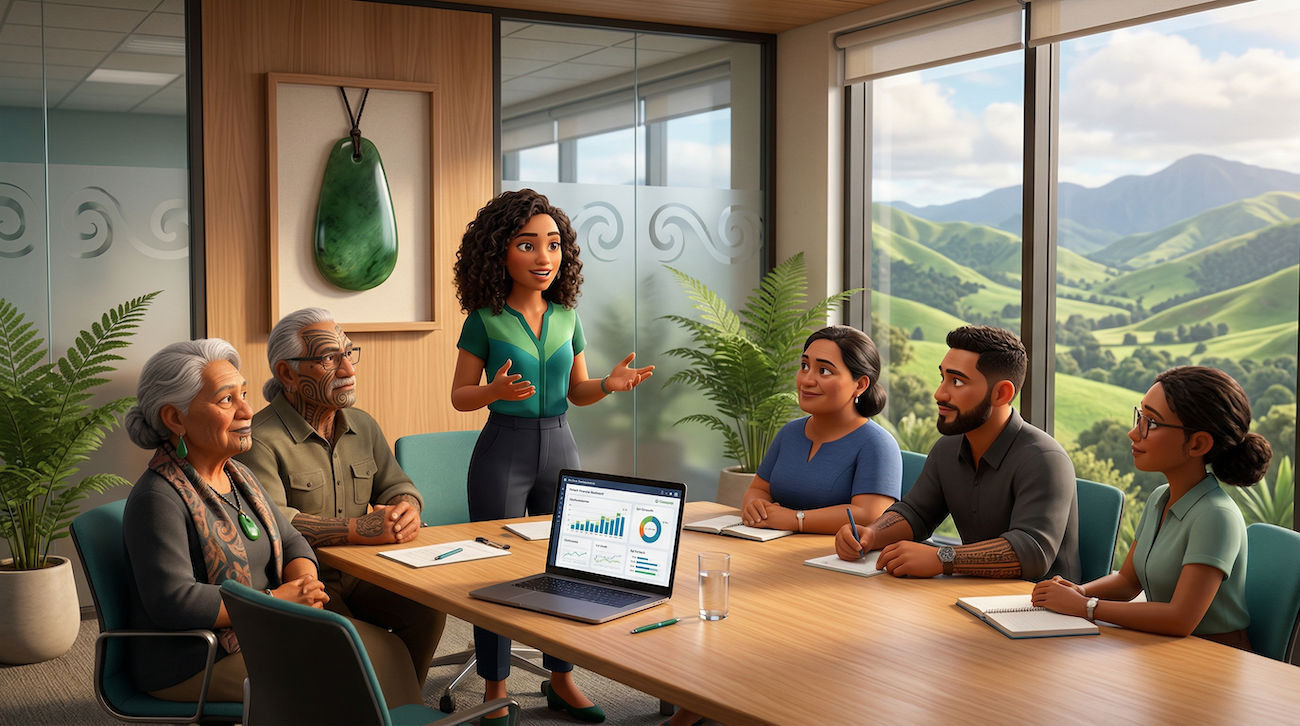
But the connection goes deeper than ESOP. Anna has been part of the Rautaki Working Group at Sharesies, a Māori strategy working group that enables Sharesies to help create financial empowerment for indigenous people in New Zealand.
Her team feeds directly into that strategy. They understand that it's not only important to have Māori and Pacific voices feeding into their products from a customer perspective, but they also actively work to bring more people from priority / minority communities into the company itself, so the people building the products reflect the people they're building for.
"Not only are we doing that, but now we've got partnerships with iwi," she says. (For Australian readers, iwi are similar to mob, the collective tribal groups.) "We're working with them so they can grow financial empowerment for their iwi. All of that is just because people are thinking differently, and Sharesies lets us do that."
It's the kind of work that turns a people function from a cost centre into something closer to a business strategy arm. Anna doesn't use those words herself, but the shift is clear.
Anna is a Pasifika leader in an industry that doesn't have many. She's a vocal advocate for Pacific Island representation in professional and leadership spaces, and she provides pro bono mentoring for Pacific Island professionals. The judges of the HR Influence Awards noted that her perspective was one the cohort "would be poorer without."
That advocacy isn't separate from her day job. It's woven through how she designs people practices, how she recruits, and how she thinks about who gets a seat at the table. When she talks about belonging versus inclusion, she's not reaching for a buzzword. She's describing something she's had to fight for.
At the end of our conversation, Anna was asked what advice she'd give her younger self about HR, work, and people.
First: people are more than a number. She says she wishes she hadn't been grounded in the mindset of huge organisations where employees were treated as headcount. That took time to unlearn.
Second: you don't know everything, and you never will. "Just be okay with that."
Third: change is constant. "So just go for the ride. Nothing's going to be the same, especially in the people space. Be ready for the unexpected."
There's a through line in all of Anna's work, from that call centre where she first got angry about unfair practices, to the fintech where she's now shaping how an entire company thinks about its people. She keeps coming back to the same question: who is this actually built for? And if the answer isn't "everyone who's in the room," she rebuilds it until it is.
Anna Liumaihetau Darling is GM of People Experience at Sharesies, Auckland. She is a 2026 HR Influence Awards Top 12 ANZ, HRNZ People's Choice nominee, and NZ HR Summit 2025 speaker. Connect with her on LinkedIn.
#HRInfluenceAwards
The HR Influence Awards 2026 Top 12 ANZ are presented by Compono.
Full details at hrinfluenceawards.com.au.
Edan Haddock went from arranging flowers to leading talent across six countries at Movember. His AI agent Joel interviews candidates so humans don't...
Teresa Lilly built the people foundations startups forget. From scaling a fintech 60% in a year to founding Culture Pilot Co, she shares what most...
Matt McFarlane went from psychology graduate to compensation consultant for Australia's fastest-growing startups. He explains why pay is never about...