



6 min read

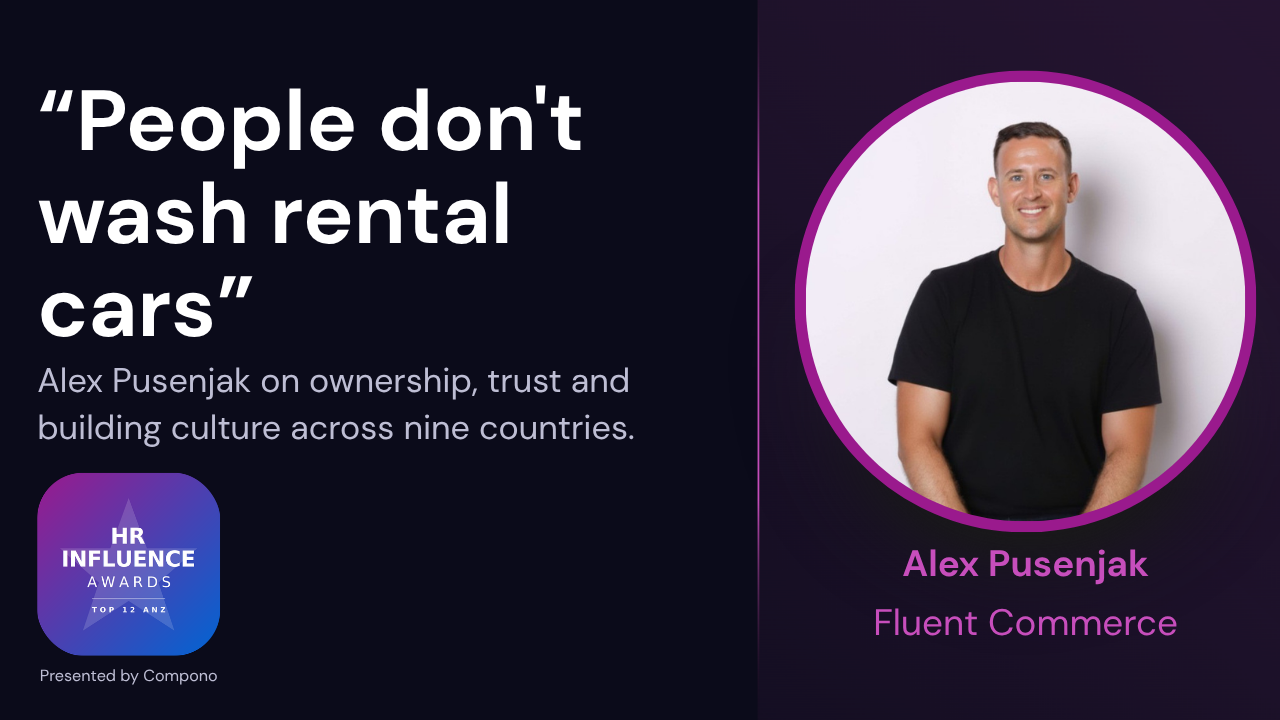
"People don't wash rental cars": Alex Pusenjak on ownership, trust and building culture across nine countries

"People don't wash rental cars": Alex Pusenjak on ownership, trust and building culture across nine countries
10:50

People don't wash rental cars, but they wash their own.

Alex Pusenjak drops this line about six minutes into our conversation, and it lands like a quiet grenade. He's talking about how you get employees to genuinely care about a company's mission when you can't outspend the competition on perks and benefits. His answer has nothing to do with perks. It has everything to do with what happens when people feel like owners of their work rather than occupiers of a seat.

"We've been incredibly intentional about taking employees on the company journey," he says. "We're essentially inviting them into the cockpit of the business. They see the dials and dashboards as we do."


Pusenjak is the Global VP of People and Culture at Fluent Commerce, a commerce technology company headquartered in Sydney with employees across nine countries. He's one of the HR Influence Awards Top 12 for 2026, recognised for building an outcomes-driven culture that has produced some hard-to-argue-with numbers: 96% employee willingness to go above and beyond and a Great Place to Work certification with a 95% positive rating. The industry awards have followed: AHRI Best Employee Experience Strategy 2023, SEEK STAR Awards 2024, back-to-back HRD Hot List appearances, and a finalist nod for Australian HR Manager of the Year.

The judges noted that "Alex has more independently validated recognitions than almost anyone in this cohort. When your engagement metrics, industry awards, and community leadership all point the same direction, the evidence speaks for itself."

Spreadsheets that lacked a pulse

His path to people leadership wasn't a straight line. Pusenjak studied commerce and commercial law at university and started his career in a completely different industry before making the jump.

"That foundation in law and commerce did give me a very clear internal compass," he says. "I always knew exactly what I didn't want to do. I didn't want to be a cog in a machine or manage spreadsheets that lacked a pulse."

What pulled him toward people and culture was a realisation about what the function actually is, when it's done properly. "It's the only function that allows you to partner directly with the business's most volatile yet most valuable asset," he says. "And that's its people."

After a decade working for US-based companies, he joined Fluent Commerce five years ago as the first boots on the ground in a people role. He saw it as the chance to influence leadership locally while building culture inside a global organisation from scratch.

Cartoon-style illustration of a professional standing at a crossroads between a grey office filled with spreadsheets and a vibrant outdoor space filled with diverse people collaborating

Bring the table

Pusenjak has little patience for people leaders who wait to be invited into business conversations. He takes a familiar HR cliché and turns it on its head.

"I often hear the expression about having a seat at the table," he says. "And I always say, don't stop asking to have a seat at the table, but actually bring the table. Or build the table."

For him, that means speaking the same language as the CFO. Understanding how the P&L runs. Knowing how the company builds its technology and takes it to market. He's not suggesting every people leader needs to become a finance expert, but he thinks they need to know enough to be useful in the rooms where decisions get made.

"You need to be alert enough to be dangerous," he says, laughing. "I've seen some people leaders struggle where they have just taken that step back. They've waited for the business to tell them what they need to do."

His argument is that the days of reactive HR are over. When you bring data-driven insights about people to leadership, you stop serving the business and start shaping its direction. "When you're talking with your leadership team or your CEO, bring the human data they need to make business decisions," he says. "You aren't serving the business. You're shaping the direction of the business."

Fair Dinkum

One of Fluent Commerce's company values is, quite literally, Fair Dinkum. It's about as Australian as it gets, and Pusenjak uses it to explain something specific about how the company operates.

"Being Fair Dinkum is about being honest and transparent with each other," he says. "Having that high trust allows employees to make decisions and to feel they're part of this journey."

That transparency extends to the business numbers. Fluent Commerce shares its dashboards and performance data openly with employees. Pusenjak acknowledges this can be uncomfortable, particularly in the early stages of a company's growth when the numbers aren't always pretty. But he sees the discomfort as a feature, not a flaw.

"For some employees, it may not be for them. And that's also okay," he says.

The trust architecture shows up most clearly in how Fluent Commerce approaches working hours. Their employee value proposition is built around "impact over hours," and Pusenjak has made that more than a slogan by making hours an irrelevant metric altogether.

"If you've got managers who are checking what time someone logs in, you're not managing performance," he says. "You're managing anxiety."

The shift forced managers to get better at defining what success actually looks like. With employees spread across nine countries (including a team in France where working hours are more strictly regulated), a traditional nine-to-five model was never realistic anyway. So they built their culture around outcomes instead.

"Having an outcomes-driven and success-driven culture is much more impactful over hours," he says.

Cartoon-style illustration of diverse office workers sitting together in an aeroplane cockpit, studying glowing dashboards displaying company performance metrics

The conductor and the orchestra

Running people strategy across nine countries means dealing with wildly different expectations. In the US, company-provided health benefits matter enormously. In France, the right to disconnect is central. In Australia and Southeast Asia, different things again.

Pusenjak's approach is straightforward: think global, act local.

"One important element is not to have a cookie-cutter model from HQ down across the regions," he says. He runs a lean team with business partners on the ground in Europe and North America who feed back what employees actually care about in each location.

He's also wary of the "poor forgotten cousin" problem, where regional offices feel disconnected from headquarters. He pushes his executive team to make sure their travel isn't just about meeting customers and attending conferences. It should include time with their people.

When it came to defining company values across all those geographies, Pusenjak ran cross-regional workshops that mixed up teams and asked employees to describe what the values meant in their own lives. The answers surprised him.

"One employee said, for me, flexibility is being able to drop off my kids, pick them up, but then being able to jump on later in the evening and speak to my team in another country," he says. "Whereas another employee would say being able to go to the gym for an hour and a half in my lunch break is really important for me."

He reaches for a musical metaphor. "We can be the conductor of the orchestra, but everyone has got their own music and their own talent to play the various notes. And that's what brings the magic."

Culture add, not culture fit

Pusenjak pushes back hard against the idea of hiring for culture fit. He prefers "culture add," and he's specific about why.

"What's that unique special sauce that you're bringing to the table?" he says. "It's almost like that extra missing ingredient to a meal. The more we're engaging our people, the more we're adding to our recipe book."

His AFL analogy makes the point simply. "If you're hiring for an AFL football team, you don't need 18 ruck men," he says. "You need people to play different roles across the ground."

He's seen what happens when hiring managers keep recruiting the same type of person. The teams get stale and the gaps in capability never close. His advice to hiring managers is pointed: don't have just one person saying yes. Build broader panels. Get multiple sets of eyes on candidates. Be conscious of your own biases.

"It could be that they went to the same school, they've got a similar work background, or whatever it is," he says. "Maybe they're the same height and they only want to hire people over six foot four."

He laughs, but the point is serious. One wrong hire, he says, can set a team back six to twelve months.

When it comes to spotting the wrong person already inside the organisation, Pusenjak watches for what he calls "silent sabotage." Employees who nod along in town halls, then go back to their desks and do things the old way. Teams that hit their numbers while the heart and soul of the organisation stays flat.

"You can have someone who hits every KPI, they can build the best tech," he says. "But if they're demoralising their entire team, look for people who don't just fit the culture but make it better."

Cartoon-style illustration of an AFL football team huddle on a sunny oval, with players of different builds and backgrounds

Look for the human answer

When asked what advice he'd give his younger self, Pusenjak doesn't hesitate. Master the business. Be brave enough to have the hard conversations. And stop looking for the HR answer.

"Don't always look for the HR answer," he says. "Start looking for the human one. People don't want to be led by a policy. They want to be seen, heard, and respected as professionals."

His closing thought pulls together the two sides of his career: the commerce graduate who understood numbers, and the people leader who understood that numbers without empathy are hollow. "Lead with empathy," he says. "But back everything up with data."

A mid-interview interruption from a passing duck breaks the moment, and both he and interviewer Rudy Crous crack up. It's the kind of thing that reminds you these conversations happen between real people in real settings, not in a studio.

"Hopefully that's a bit of a winning formula," Pusenjak says.

Given the numbers behind his work at Fluent Commerce, it's hard to argue with him.


Alex Pusenjak is Global VP, People & Culture at Fluent Commerce, Sydney. He is a 2026 HR Influence Awards Top 12 ANZ, HRD Hot List 2024 and 2025, AHRI Best Employee Experience Strategy 2023, SEEK STAR Awards Winner 2024, finalist for Australian HR Manager of the Year (AHRI Awards 2024), and Transform Sydney Chapter Lead. Connect with him on LinkedIn.


#HRInfluenceAwards


hr-influence-awards-social-card-2

The HR Influence Awards 2026 Top 12 ANZ are presented by Compono.
Full details at hrinfluenceawards.com.au.

Related

"Whatever happens in an interview, times it by 10": Teresa Lilly on hiring, culture, and the hard calls startups avoid

Teresa Lilly didn't plan a career in HR. She was living in Boston, took a people role at a startup, and something clicked.

Read More
How transparency builds real trust - Sharon Gray

How transparency builds real trust - Sharon Gray

Sharon Gray's kids made the call. She'd come home with two job offers, laid them both out on the kitchen table, and asked what she should do. The...

Read More
The Post-It Note Test - Drew Mayhills

The Post-It Note Test - Drew Mayhills

Drew Mayhills keeps a Post-It note on his desk. It's a tally. He marks it every time someone on his team volunteers a new idea - unprompted, openly,...

Read More